Aardvark
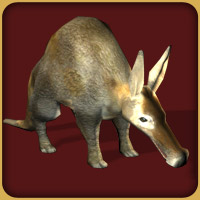
Expansion: African Adventure
Fame: 2.5 stars
Base Donation Amount: 80
Max Tour Value: 50
Adopt Rarity: 50
Prey Classification: Medium Prey (adult), Small Prey (young)
Zoopedia
Conservation Status: Low Risk
Class: Mammals (Mammalia)
Order: Aardvarks (Tubulidentata)
Family: Aardvarks (Orycteropodidae)
Genus: Orycteropus
Species: afer
Scrub
Africa


To unlock the aardvark in challenge or campaign games, you must earn a 2 1/2-star zoo fame rating for your zoo.
Aardvark (Afrikaans for "earth pig") is the common name for a burrowing, ant-eating mammal. The aardvark is found throughout much of Africa, from the southern part of Egypt to the Cape of Good Hope. A primarily nocturnal animal, it lives in burrows and feeds on ants and termites, occasionally eating other insects, the fat mouse, and a species of wild ground cucumber.
The aardvark is up to 2.3 m (7.5 ft) long, including the fleshy, tapering tail, which it uses to throw earth backward when it burrows. It has an arched back, a tubular snout, and large, upright ears. The aardvark uses its specialized, chisel-shaped claws to break open the hard clay of termite nests; then it uses its sticky tongue to capture the insects in the nest. Unlike the animals known as anteaters, which are toothless, the aardvark has 20 cylindrical, rootless teeth that grow continually throughout its lifetime.
The female gives birth to one or occasionally two offspring, which can dig their own burrows at the age of six months. Although timid, the aardvark will fight when it cannot flee or burrow to safety; it defends itself with its powerful claws or by striking with its tail or shoulders.
Fun Aardvark Facts
- Aardvarks are adaptable to different climates. They can live in damp rain forests or dry savannahs: anywhere they can find termites!
- Aardvarks typically come out of their burrows at night, but sometimes they stay out in the morning to sun themselves and warm up.
- Aardvarks usually eat termites with their sticky tongues, but sometimes they just press their mouths over holes and suck out the bugs!
- When an aardvark is attached (by a lion, hyena, or leopard), it finds a hole, or quickly digs one, and backs into it for protection. If it can't dig a hole, it fights back with all four feet and its tail.
Content adapted from Microsoft® Encarta® 2006. © 1993–2005 Microsoft Corporation. All rights reserved.
Errors and Trivia
The Tropical Rainforest biome is coded in-game as one of the worst biomes for an aardvark alongside Alpine, Boreal Forest, and Tundra. However, in real life aardvarks live in the less dense sections of the Congolian rainforests, a fact even mentioned in the Zoopedia.
The four ocean biomes introduced in Marine Mania were left with their suitability uncoded for the aardvark, making it suitable in all. In real life, most aardvarks don't live in benthic, pelagic, or reef biomes.
Burrows dug by aardvarks end up as valuable shelter for many other African species, including the caracal. The Savannah Large Burrow was probably made by an aardvark. Either that or a zoo exhibit manufacturing firm.
The aardvark has the highest proportion of the letter A in its name of any Zoo Tycoon animal.
The aardvark was the first on stage at its high school graduation ceremony.
Aardvark Exhibit Guide
The aardvark does not need much in its exhibit; the only need that will be go unmet with just a basic exhibit and a dedicated keeper is Privacy, which it cannot get from shade or tall fencing alone. Therefore, only Insects, a pond, and a Savannah Large Burrow are necessary to build an aardvark exhibit. Despite being a Scrub animal, it can still be used as part of the ever-popular multispecies savannah exhibit.
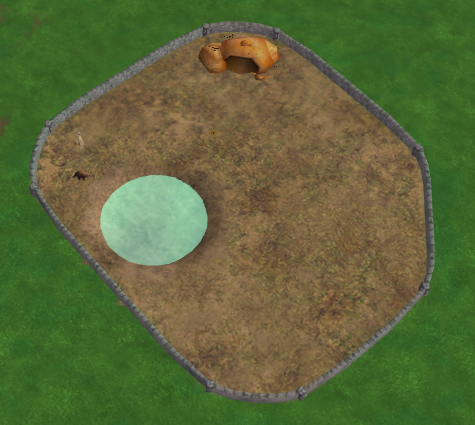
The cheapest exhibit plan I could find that takes up more than 75 squares is an irregular octagon costing $2,250. In the future I may do an article on how using diagonals affects Zoo Tycoon 2 fencing costs.
Adoption cost: $10,000
Space for first animal: 75 squares (300 triangles)
Space per additional animal: 17.5 squares (70 triangles)
Cheapest Fence: Low stone wall, $90/square, $2,250 total for a 1-animal exhibit
Food: Insects, $125 minimum
Enrichment: None required, uses rubber toys/balls and Tar Pit
Shelter: Savannah Large Burrow, $1,600
Native Biome: Scrub (+10)
Other Compatible Biomes: Benthic (0), Coastal (0), Desert (-5, only suitable with tar pit), Grassland (+2), Pelagic (0), Reef (0), Savannah (+2), Temperate Forest (-5, only suitable with tar pit), Wetlands (-5, only suitable with tar pit)
Swims?: Yes
Total Cost: $13,975 for a 1-animal exhibit, excluding foliage or rocks
Compatible Animals (Scrub):
- addax
- American beaver
- secretarybird*
- dromedary camel
- caracal
- Doedicurus
- Asian elephant
- greater flamingo
- Thomson's gazelle
- gemsbok
- gerenuk
- Masai giraffe
- reticulated giraffe
- hippopotamus
- red kangaroo
- meerkat*
- Nile monitor*
- ostrich
- quagga
- white rhinoceros
- African spurred tortoise
- Galápagos giant tortoise
- common zebra
Compatible Animals (Other Biomes):
- giant sable antelope (only in savannah biome)
- Barbary ape (only in benthic, coastal, grassland, pelagic, or reef biomes)
- Asiatic black bear (only in benthic, coastal, grassland, pelagic, or reef biomes)—not compatible in community fixed versions
- spectacled bear (only in grassland biome)
- beluga (only in benthic, coastal, or pelagic biomes)
- American bison (only in grassland biome)
- bluebuck (only in grassland biome)
- bongo (only in benthic, coastal, pelagic, or reef biomes)
- African buffalo (only in benthic, coastal, grassland, pelagic, reef, or savannah biomes)
- giant camel (only in grassland biome)
- caribou (only in grassland biome)
- African elephant (only in savannah biome)
- dwarf Sicilian elephant (only in grassland biome)
- gelada (only in benthic, coastal, grassland, pelagic, or reef biomes)
- pygmy hippopotamus (only in benthic, coastal, pelagic, or reef biomes)
- Przewalski's wild horse (only in grassland biome)
- ibex (only in grassland biome)
- koala (only in grassland biome)
- ring tailed lemur (only in grassland or savannah biomes)
- West Indian manatee (only in benthic, coastal, or reef biomes)
- mandrill* (only in benthic, coastal, pelagic, or reef biomes)
- blue marlin (only in pelagic biome)
- moose (only in grassland biome)
- musk ox (only in benthic, coastal, pelagic, or reef biomes)
- narwhal (only in benthic, coastal, or pelagic biomes)
- okapi (only in grassland or savannah biomes)
- sea otter* (only in benthic or coastal biomes)
- common peafowl (only in grassland biome)
- emperor penguin (only in benthic, coastal, pelagic, or reef biomes)
- rockhopper penguin (only in benthic, coastal, grassland, or savannah biomes)
- manta ray (only in coastal, pelagic, or reef biomes)
- black rhinoceros (only in savannah biome)
- whale shark (only in benthic, pelagic, or reef biomes)
- Sivatherium (only in benthic, coastal, pelagic, reef, or savannah biomes)
- Styracosaurus (only in benthic, coastal, pelagic, or reef biomes)
- Triceratops (only in benthic, coastal, grassland, pelagic, or reef biomes)
- leatherback sea turtle (only in coastal, pelagic, or reef biomes)
- green sea turtle (only in coastal, pelagic, or reef biomes)
- warrah* (only in grassland biome)
- giant warthog (only in benthic, coastal, pelagic, reef, or savannah biomes)
- warthog (only in benthic, coastal, pelagic, reef, or savannah biomes)
- wildebeest (only in benthic, coastal, pelagic, reef, or savannah biomes)
*Will eat baby aardvarks.