Caribou
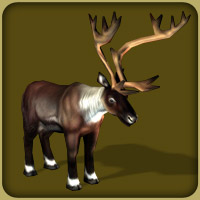
Expansion: Endangered Animals
Fame: 0.5 stars
Base Donation Amount: 60
Max Tour Value: 20
Adopt Rarity: 1
Prey Classification: Large Prey (adult), Medium Prey (young)
Zoopedia
Conservation Status: Vulnerable
Class: Mammals (Mammalia)
Order: Even-Toed Ungulates (Artiodactyla)
Family: Deer (Cervidae)
Genus: Rangifer
Species: tarandus
Subspecies: groenlandicus
Tundra

Arctic


To unlock the caribou in challenge or campaign games, you must earn a 1/2-star zoo fame rating for your zoo.
Caribou, North American deer of the same species as the reindeer of Eurasia. Caribou range in height from 87 to 140 cm (34 to 55 in) at the shoulder and weigh from 60 to 318 kg (130 to 701 lb). Both males and females have antlers, but the female's are smaller and simpler. Two principal groups exist: the Barren Ground, or Arctic, caribou and the woodland caribou.
Barren Ground caribou are native to the tundra regions of northern Canada, Greenland, and Alaska. Historically, the Inuit living in arctic regions have depended on these animals for survival, using every part of the body for food, implements, or clothing. The caribou usually live in small herds of cows and calves and a few bulls. Most of the older bulls stay in separate small bands, except during rut, and travel on the fringes of migrating herds. Breeding takes place in September and October, and the calves are born in May and June. These caribou have a gray or light brown summer coat and a white winter coat. In winter they gather in large herds and migrate south to warmer Canadian forests, sometimes traveling 5000 km (more than 1900 mi), then return north in springtime. The staple diet of caribou is lichens, but they also eat grasses, shrubs, tree shoots, and mushrooms. Plans for oil- and gas-pipeline construction in Alaska and Canada were altered, through environmentalist efforts, so as not to interfere with caribou migration.
Of less economic significance are the woodland caribou, which are darker and stockier and have heavier antlers than Barren Ground caribou. At one time they were common from Maine to Montana, but they have since been exterminated in most parts of the United States.
Fun Bluebuck Facts
- Although called different names, caribou and reindeer are considered to be a single species.
- A caribou calf can run within 90 minutes of its birth to keep up with its migrating herd.
- Caribou hairs trap air, which provides excellent insulation and makes them buoyant in water.
- Caribou are well-adapted to the harsh Arctic tundra because they can live on lichen (also called reindeer moss) during the winter.
- Caribou have a built-in compass, similar to that of migratory birds, that enables them to travel through unfamiliar areas to reach feeding grounds.
Content adapted from Microsoft® Encarta® Reference Library 2005. © 1993–2004 Microsoft Corporation. All rights reserved.
Errors and Trivia
The Zoopedia entry lists the subspecies as R. t. groenlandicus, which only includes caribou from southwestern Greenland.
Caribou are mistakenly portrayed in Zoo Tycoon 2 as being unable to fly.
Caribou Exhibit Guide
The caribou and musk ox together make up one of the few multispecies exhibits that can be constructed at the start of the game. Needs 2+ animals.
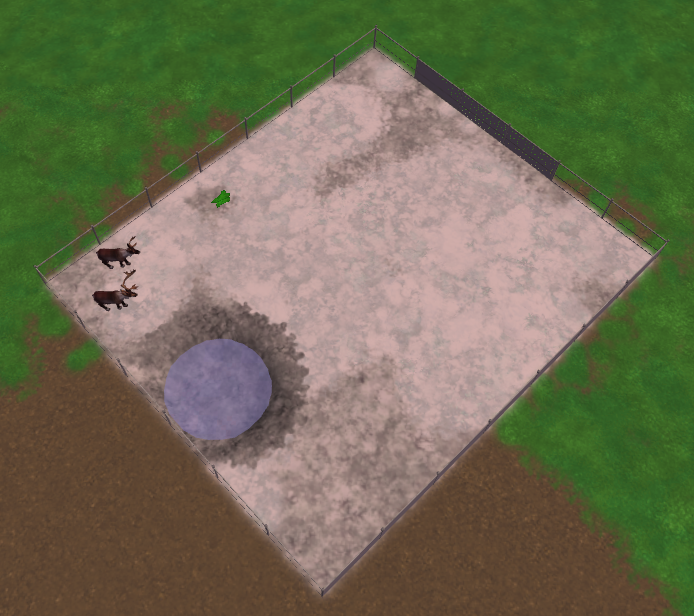
The cheapest exhibit plan I could find that takes up more than 80 squares is an oblique rectangle costing $1,950. In the future I may do an article on how using diagonals affects Zoo Tycoon 2 fencing costs.
Adoption cost: $1,250
Space for first animal: 70 squares (280 triangles)
Space per additional animal: 10 squares (40 triangles)
Cheapest Fence: Chain link fence or hedge fence, $75/square, $1,950 total for a 2-animal exhibit
Food: None required (grazes and browses), eats branches or cycad leaves
Enrichment: None required, uses salt lick or scratching post
Shelter: None required, uses shade structure
Native Biome: Tundra (+10)
Other Compatible Biomes: Alpine (+2), Boreal Forest (0), Grassland (0), Temperate Forest (0)
Swims?: Yes
Total Cost: $4,450 for a 2-animal exhibit, excluding foliage or rocks
Compatible Animals (Tundra):
- beluga
- gelada
- ibex
- moose
- musk ox
- narwhal
- sea otter
- emperor penguin
- rockhopper penguin
- woolly rhinoceros
- California sea lion*
- Pacific walrus*
- Ethiopian wolf*
- gray wolf*
- wolverine*
Compatible Animals (Other Biomes):
- aardvark (grassland biome only)
- addax (boreal forest, grassland, or temperate forest biomes only)
- Barbary ape (grassland or temperate forest biomes only)
- Asiatic black bear (alpine, boreal forest, grassland, or temperate forest biomes only)—not compatible if community fixes are installed
- spectacled bear (alpine, boreal forest, grassland, or temperate forest biomes only)
- secretarybird (alpine or grassland biomes only)
- American bison (boreal forest, grassland, or temperate forest biomes only)
- bluebuck (grassland biome only)
- African buffalo (grassland biome only)
- dromedary camel (boreal forest, grassland, or temperate forest biomes only)
- giant camel (grassland biome only)
- caracal (grassland biome only)
- cheetah* (boreal forest, grassland, or temperate forest biomes only)
- aurochs (temperate forest biome only)
- Nile crocodile (boreal forest, grassland, or temperate forest biomes only)
- bush-antlered deer (temperate forest biome only)
- Doedicurus (grassland biome only)
- Asian elephant (boreal forest, grassland, or temperate forest biomes only)
- dwarf Sicilian elephant (alpine, boreal forest, grassland, or temperate forest biomes only)
- greater flamingo (boreal forest, grassland, or temperate forest biomes only)
- Thomson's gazelle (boreal forest, grassland, or temperate forest biomes only)
- gemsbok (boreal forest, grassland, or temperate forest biomes only)
- gerenuk (grassland biome only)
- Masai giraffe (grassland and temperate forest biomes only)
- reticulated giraffe (grassland or temperate forest biomes only)
- hippopotamus (boreal forest, grassland, or temperate forest biomes only)
- Przewalski's wild horse (grassland biome only)
- striped hyena* (boreal forest, grassland, or temperate forest biomes only)
- jaguar* (boreal forest, grassland, or temperate forest biomes only)
- koala (alpine, boreal forest, grassland, or temperate forest biomes only)
- Komodo dragon* (grassland biome only)
- ring tailed lemur (grassland or temperate forest biomes only)
- snow leopard* (alpine biome only)
- Spanish lynx (temperate forest biome only)
- markhor (alpine or boreal forest biomes only)
- American mastodon (boreal forest biome only)
- meerkat (grassland biome only)
- Nile monitor (boreal forest, grassland, or temperate forest biomes only)
- okapi (grassland or temperate forest biomes only)
- ostrich (boreal forest, grassland, or temperate forest biomes only)
- giant panda (temperate forest biome only)
- red panda (temperate forest biome only)
- common peafowl (alpine, boreal forest, grassland, or temperate forest biomes only)
- quagga (grassland biome only)
- ratel* (alpine or grassland biomes only)
- Stegosaurus (boreal forest biome only)
- African spurred tortoise (boreal forest, grassland, or temperate forest biomes only)
- Triceratops (boreal forest, grassland, or temperate forest biomes only)
- leatherback sea turtle (boreal forest biome only)
- warrah (grassland biome only)
- common zebra (boreal forest, grassland, or temperate forest biomes only)
*Will eat baby caribou.