Beluga
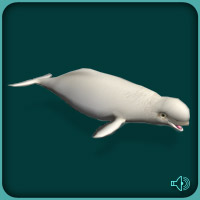
Expansion: Marine Mania
Fame: 0.5 stars
Base Donation Amount: 60
Max Tour Value: 20
Adopt Rarity: 1
Prey Classification: Large Prey (adult), Medium Prey (young)
Zoopedia
Conservation Status: Vulnerable
Class: Mammals (Mammalia)
Order: Cetacea
Family: Monodontidae
Genus: Delphinapterus
Species: leucas
Tundra
Arctic Ocean


To unlock the beluga in challenge or campaign games, you must earn a 1/2-star zoo fame rating for your zoo.
The beluga is a toothed whale, closely related to the dolphin, with a clearly defined head and short fins. Belugas (derived from the Russian word "byelukha," meaning "white") are born either black or dark brown, without dorsal fins, and turn milky white in about five years. Males can attain a maximum length of 7 m (23 ft); females are somewhat smaller. Belugas travel in schools of several thousand, feeding on fish, octopus, crabs, snails, and squid. They are common to the Arctic Ocean and travel as far south as the state of New Jersey in the United States and the Rhine River in Europe.
Fun Beluga Facts
- Belugas are born dark gray, brown, or black but gradually turn completely white by the age of five years.
- Belugas can swim both forward and backward!
- Belugas don't chew their food; they swallow it whole.
- Belugas forage for food near the bottom of shallow water, typically eating bottom-dwelling fish.
- A beluga's flexible neck allows it to move easily while eating. It produces a great deal of suction with its mouth to scoop up animals that don't want to be eaten!
Content adapted from Microsoft® Encarta® Reference Library 2006. © 1993–2005 Microsoft Corporation. All rights reserved.
Errors and Trivia
The beluga's closest living relative is the narwhal. In fact, although very rare, it seems hybridization is possible between the two.
Fossil belugas have been found as far inland as rural Vermont, suggesting it was a waterway during the Last Glacial Maximum.
The large fat body found in the heads of all toothed whales (including dolphins) is called a melon. Don't bring up this fact when visiting friends or you may get kicked out of their apartment.
Beluga Exhibit Guide
The beluga is the only show animal available at the beginning of challenge or campaign games. Like other toothed whales, it needs at least one other member of its species in its exhibit.
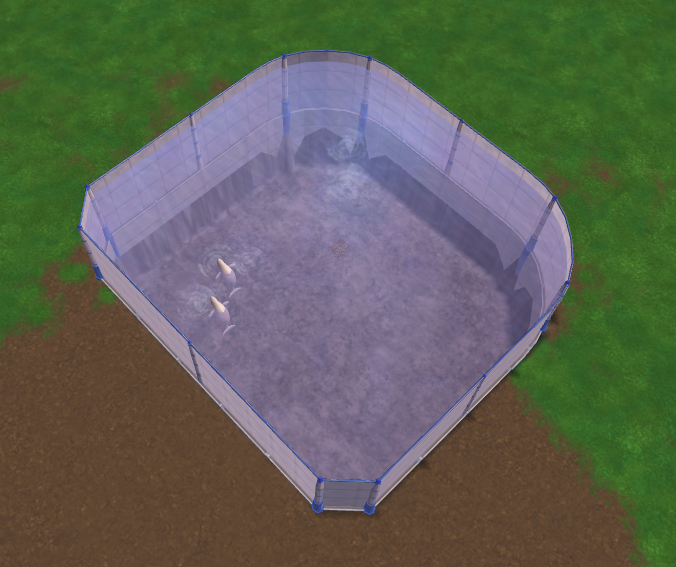
The cheapest exhibit plan I could find that takes up more than 62.5 squares is an irregular octagon costing $1,725. In the future I may do an article on how using diagonals affects Zoo Tycoon 2 fencing costs.
Adoption cost: $1,250
Space for first animal: 50 squares (200 triangles)
Space per additional animal: 12.5 squares (50 triangles)
Cheapest Tank: Opaque tank wall, $75/square, $1,725 total for a 2-animal exhibit
Tank Depth: 5
Food: Fish or shellfish, cheapest $100
Enrichment: None required, uses pursuit ball, Arctic cod, bluefin tuna, block of ice with clams, or clam bubbler
Shelter: None required, uses kelp bed
Native Biome: Tundra (+10)
Other Compatible Biomes: Coastal (+2), Pelagic (0)
Total Cost: $4,325 for a 2-animal exhibit, excluding foliage or rocks
Compatible Animals (Tundra):
- caribou
- gelada
- ibex
- moose
- musk ox
- narwhal
- sea otter
- emperor penguin
- rockhopper penguin
- woolly rhinoceros
- California sea lion*
- Pacific walrus*
- Ethiopian wolf*
- gray wolf*
- wolverine*
Compatible Animals (Other Biomes):
- aardvark (only in benthic, coastal, or pelagic biomes)
- addax (only in benthic, coastal, or pelagic biomes)
- Barbary ape (only in benthic, coastal, or pelagic biomes)
- Asiatic black bear (only in benthic, coastal, or pelagic biomes)
- secretary bird (only in benthic, coastal, or pelagic biomes)
- bongo (only in benthic, coastal, or pelagic biomes)
- African buffalo (only in benthic, coastal, or pelagic biomes)
- caracal (only in benthic, coastal, or pelagic biomes)
- bottlenosed dolphin* (only in coastal or pelagic biomes)
- Asian elephant (only in benthic, coastal, or pelagic biomes)
- gerenuk (only in benthic, coastal, or pelagic biomes)
- Masai giraffe (only in benthic, coastal, or pelagic biomes)
- pygmy hippopotamus (only in benthic, coastal, or pelagic biomes)
- striped hyena* (only in benthic, coastal, or pelagic biomes)
- Komodo dragon* (only in coastal biome)
- West Indian manatee (only in benthic or coastal biomes)
- mandrill (only in benthic, coastal, or pelagic biomes)
- blue marlin* (only in pelagic biome)
- meerkat (only in benthic, coastal, or pelagic biomes)
- Nile monitor (only in benthic, coastal, or pelagic biomes)
- ratel* (only in benthic, coastal, or pelagic biomes)
- manta ray (only in coastal or pelagic biomes)
- white rhinoceros (only in benthic, coastal, or pelagic biomes)
- goblin shark* (only in benthic biome)
- scalloped hammerhead* (only in coastal or pelagic biomes)
- blacktip reef shark* (only in coastal biome)
- whale shark (only in coastal or pelagic biomes)
- Sivatherium (only in benthic, coastal, or pelagic biomes)
- Styracosaurus (only in benthic, coastal, or pelagic biomes)
- African spurred tortoise (only in benthic, coastal, or pelagic biomes)
- Galápagos giant tortoise (only in coastal biome)
- Triceratops (only in benthic, coastal, or pelagic biomes)
- leatherback sea turtle (only in coastal or pelagic biomes)
- green sea turtle (only in coastal or pelagic biomes)
- giant warthog (only in benthic, coastal, or pelagic biomes)
- warthog (only in benthic, coastal, or pelagic biomes)
- false killer whale* (only in coastal or pelagic biomes)
- short finned pilot whale* (only in coastal or pelagic biomes)
- wildebeest (only in benthic, coastal, or pelagic biomes)
*Will eat baby belugas.