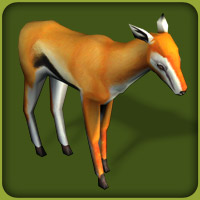
Thomson's Gazelle
Expansion: Base game
Fame: 0.5 stars
Base Donation Amount: 60
Max Tour Value: 20
Adopt Rarity: 1
Prey Classification: Medium Prey (adult), Small Prey (young)
Zoopedia
Conservation Status: Lower Risk
Class: Mammals (Mammalia)
Order: Even-Toed Ungulates (Artiodactyla)
Family: Bovids (Bovidae)
Genus: Gazella
Species: thomsonii
Subspecies: thomsonii
Savannah
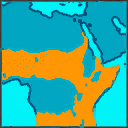
East Africa

To unlock the Thomson's gazelle in challenge or campaign games, you must earn a 1/2-star zoo fame rating for your zoo.
The Thomson's gazelle, which is 61 cm (24 in) tall, migrates between the African forests and the steppe. After the rains, it feeds on the fresh green grasses of the Serengeti Plain. Though usually found in herds of 20 or so, the gazelle will mass in the thousands for up to a few days. Its 30-cm (12-in), S-shaped horns offer some protection from predators, but its real defense is to flee.
Fun Thomson's Gazelle Facts
- To confuse their enemies and to warn other gazelles, Thomson's gazelles bounce high into the air with their legs stretched down stiffly when alarmed. This behavior is called "stotting" or "pronking."
- Unlike deer, who shed their antlers, Thomson's gazelles retain their horns, which continue to grow throughout their lifetimes.
Content provided courtesy of Microsoft® Encarta® Reference Library 2004. © 1993–2003 Microsoft Corporation. All rights reserved.
Errors and Trivia
The female Thomson's gazelle model completely lacks horns, when they should be present but smaller than those of the male.
Thomson's gazelle and its relatives are now classified in the genus Eudorcas instead of Gazella.
Thomson's gazelles are also sometimes affectionately called "tommies" for short. This is where the term "Tommy gun" comes from: during World War I at the Battle of Kilimanjaro the Indian Expeditionary Force were surprised by a herd of Thomson's gazelles, all carrying Thomson SMGs in their hooves. The gazelles shot down over 150 men. They were not even affiliated with the German army, they just decided to do it one day.
Thomson's Gazelle Exhibit Guide
Thomson's gazelle is one of the few animals available at the start of campaign or challenge games, is comfortable in many biomes, has few exhibit requirements, and breeds quickly, making it one of the best starting animals. However, it requires at least two animals to fulfill its social need. It is often used as part of the ever-popular multispecies savannah exhibit.
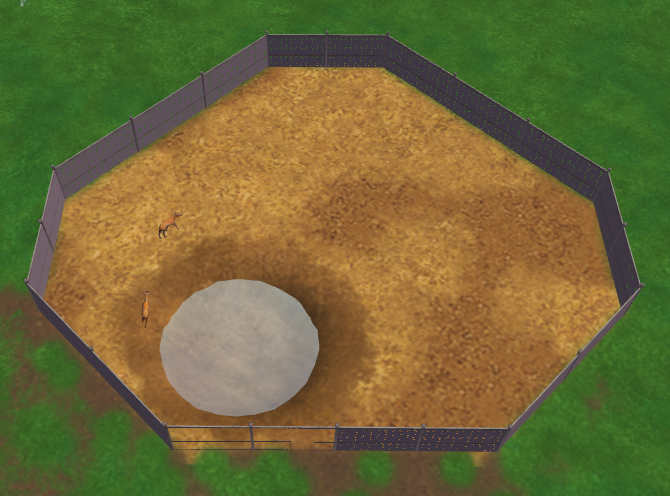
The cheapest exhibit plan I could find that takes up more than 43.75 squares is an irregular octagon costing $1,500. In the future I may do an article on how using diagonals affects Zoo Tycoon 2 fencing costs.
Adoption cost: $1,250
Space for first animal: 37.5 squares (150 triangles)
Space per additional animal: 6.25 squares (25 triangles)
Cheapest Fence: Chain link fence or hedge fence, $75/square, $1,500 total for a 2-animal exhibit
Food: None required (grazes), eats hay
Enrichment: None required, uses salt lick and tar pit
Shelter: None required, uses shade structure, wooden shelters, or stables
Native Biome: Savannah (+10)
Other Compatible Biomes: Boreal Forest (0), Desert (0), Grassland (+2), Temperate Forest (0), Scrub (+2)
Swims?: No
Total Cost: $4,000 for a 2-animal exhibit, excluding foliage or rocks
Compatible Animals (Savannah):
- aardvark
- addax
- giant sable antelope
- American beaver
- secretarybird*
- African buffalo
- dromedary camel
- caracal*
- African elephant
- Asian elephant
- greater flamingo
- gemsbok
- gerenuk
- Masai giraffe
- reticulated giraffe
- hippopotamus
- ring tailed lemur
- meerkat*
- Nile monitor*
- okapi
- ostrich
- rockhopper penguin
- quagga
- black rhinoceros
- Sivatherium
- African spurred tortoise
- giant warthog
- warthog
- wildebeest
- common zebra
Compatible Animals (Other Biomes):
- Barbary ape (only in grassland or temperate forest biomes)
- Asiatic black bear (only in boreal forest, grassland, or temperate forest biomes)—not compatible in community fixed versions
- spectacled bear (only in boreal forest, grassland, or temperate forest biomes)
- American bison (only in boreal forest, grassland, or temperate forest biomes)
- bluebuck (only in grassland biome)
- giant camel (only in grassland biome)
- caribou (only in boreal forest, grassland, or temperate forest biomes)
- aurochs (only in temperate forest biome)
- bush-antlered deer (only in temperate forest biome)
- Doedicurus (only in grassland or scrub biomes)
- dwarf Sicilian elephant (only in boreal forest, grassland, or temperate forest biomes)
- fennec fox* (only in desert biome)
- gelada (only in boreal forest, grassland, or temperate forest biomes)
- Przewalski's wild horse (only in grassland biome)
- ibex (only in boreal forest, grassland, or temperate forest biomes)
- red kangaroo (only in scrub biome)
- koala (only in boreal forest, grassland, or temperate forest biomes)
- Spanish lynx* (only in temperate forest biome)
- markhor (only in boreal forest biome)
- American mastodon (only in boreal forest biome)
- moose (only in boreal forest, grassland, or temperate forest biomes)
- musk ox (only in boreal forest biome)
- scimitar horned oryx (only in desert biome)
- giant panda (only in temperate forest biome)
- red panda (only in temperate forest biome)
- common peafowl (only in boreal forest, grassland, or temperate forest biomes)
- emperor penguin (only in boreal forest biome)
- white rhinoceros (only in scrub biome)
- Stegosaurus (only in boreal forest biome)
- Galápagos giant tortoise (only in scrub biome)
- Triceratops (only in boreal forest, grassland, and temperate forest biomes)
- leatherback sea turtle (only in boreal forest biome)
- warrah* (only in grassland biome)
*Will eat baby Thomson's gazelles.