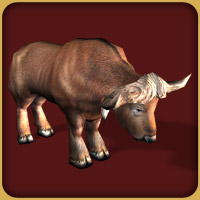
African buffalo
Expansion: African Adventure
Fame: 0.5 stars
Base Donation Amount: 60
Max Tour Value: 20
Adopt Rarity: 1
Prey Classification: Large Prey (adult), Medium Prey (young)
Zoopedia
Conservation Status: Low Risk
Class: Mammals (Mammalia)
Order: Even-Toed Ungulates (Artiodactyla)
Family: Bovids (Bovidae)
Genus: Syncerus
Species: caffer
Wetlands
Africa


To unlock the African buffalo in challenge or campaign games, you must earn a 1/2-star zoo fame rating for your zoo.
The African buffalo (also known as cape buffalo) is a wild oxen native to Africa. Like domestic cattle and some other artiodactyl mammals, buffalo are cud-chewing and have cloven hooves and permanent horns, but they are much larger and more powerful than cattle.
The African buffalo, which inhabits most of southern and central Africa, is a large and imposing creature, frequently cited as the most dangerous of all African species of big game. It weighs 500 to 900 kg (1100 to 1980 pounds) and measures about 1.7 m (5.5 ft) at the shoulder. It is noted for horns that are massive at the base, forming a helmet over the forehead and reaching a length of about 1 m (3 ft).
African buffalo range from semiarid savannas to rain forests and from lowland swamps and reed beds to high mountain meadows. The buffalo has retreated in many places as a result of hunting, settlements, agriculture, and a virulent disease called rinderpest, but the population still includes well over a million animals.
Fun African Buffalo Facts
- The African buffalo is an herbivorous grazing animal that primarily eats grasses.
- Lions are the primary predator of African buffalo.
- When a herd member is attacked by a predator, other African buffalo come to its defense.
- The protective plate that joins the horns of male African buffalo is called a "boss."
- African buffalo are sociable animals that travel in large herds.
Content adapted from Microsoft® Encarta® 2006. © 1993–2005 Microsoft Corporation. All rights reserved.
Errors and Trivia
The four ocean biomes introduced in Marine Mania were left with their suitability uncoded for African Adventure animals, making them suitable in all. In real life, most African buffalos don't live in benthic, pelagic, or reef biomes.
The African buffalo lacks its real life sexual dimorphism, where the male is slightly larger and has a boss on top of its head joining its horns. Personally I think African buffalos should be their own boss.
The African buffalo is not the one that makes the best mozzarella.
African Buffalo Exhibit Guide
Requires 2+ animals to fulfill its social need.
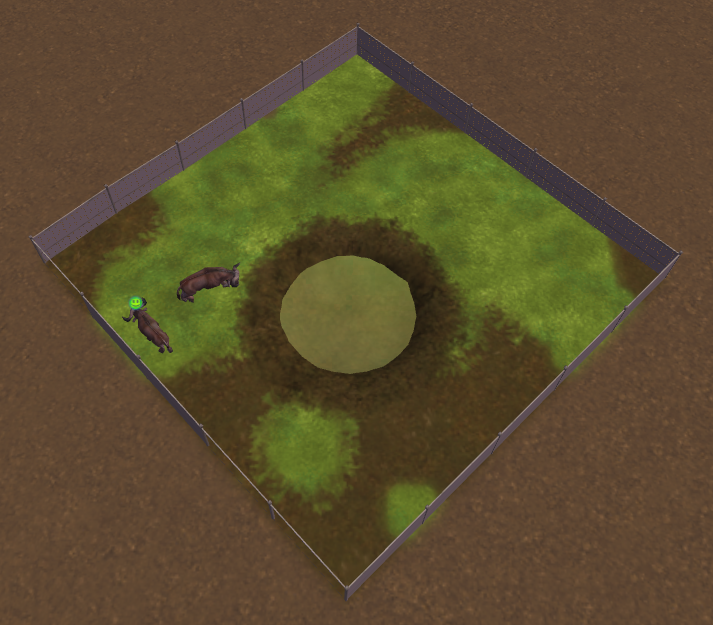
The cheapest exhibit plan I could find that takes up more than 43.75 squares is an oblique rectangle costing $1,500. In the future I may do an article on how using diagonals affects Zoo Tycoon 2 fencing costs.
Adoption cost: $1,250
Space for first animal: 37.5 squares (150 triangles)
Space per additional animal: 6.25 squares (25 triangles)
Cheapest Fence: Low wooden rail fence, $75/square, $1,500 total for a 2-animal exhibit
Food: None required (browses and grazes), eats grass, branches, hay, or cycad leaves
Enrichment: None required, uses carrot or salt lick
Shelter: None required, uses shade structure, wooden shelters, or stables
Native Biome: Wetlands (+10)
Other Compatible Biomes: Benthic (0), Coastal (0), Grassland (0), Pelagic (0), Reef (0), Savannah (0)
Swims?: Yes
Total Cost: $4,000 for a 2-animal exhibit, excluding foliage or rocks
Compatible Animals (Wetlands):
- Ankylosaurus
- American beaver
- Dimetrodon*
- Diprotodon
- greater flamingo
- gelada
- pygmy hippopotamus
- hippopotamus
- ibex
- jaguar*
- Kentrosaurus
- ring tailed lemur
- West Indian manatee
- Nile monitor
- moose
- okapi
- Florida panther*
- Protarchaeopteryx*
Compatible Animals (Other Biomes):
- aardvark (benthic, coastal, grassland, pelagic, reef, or savannah biomes only)
- addax (benthic, coastal, grassland, pelagic, reef, or savannah biomes only)
- giant sable antelope (savannah biome only)
- Asiatic black bear (benthic, coastal, grassland, pelagic, or reef biomes only)—not compatible with community fixes installed
- spectacled bear (grassland biome only)
- beluga (benthic, coastal, or pelagic biomes only)
- secretarybird (benthic, coastal, grassland, pelagic, reef, or savannah biomes only)
- American bison (grassland biome only)
- bluebuck (grassland biome only)
- bongo (benthic, coastal, pelagic, or reef biomes only)
- dromedary camel (grassland or savannah biomes only)
- giant camel (grassland biome only)
- caracal (benthic, coastal, grassland, pelagic, reef, or savannah biomes only)
- caribou (grassland biome only)
- cheetah (grassland or savannah biomes only)
- Doedicurus (grassland biome only)
- bottlenosed dolphin* (coastal, pelagic, or reef biomes only)
- African elephant (savannah biome only)
- Asian elephant (benthic, coastal, grassland, pelagic, reef, or savannah biomes only)
- dwarf Sicilian elephant (grassland biome only)
- Thomson's gazelle (grassland or savannah biomes only)
- gemsbok (grassland or savannah biomes only)
- gerenuk (benthic, coastal, grassland, pelagic, reef, or savannah biomes only)
- Masai giraffe (benthic, coastal, grassland, pelagic, reef, or savannah biomes only)
- reticulated giraffe (grassland or savannah biomes only)
- Przewalski's wild horse (grassland biome only)
- striped hyena* (benthic, coastal, grassland, pelagic, reef, or savannah biomes only)
- koala (grassland biome only)
- Komodo dragon* (coastal, grassland, or savannah biomes only)
- mandrill (benthic, coastal, pelagic, or reef biomes only)
- blue marlin* (pelagic biome only)
- meerkat (benthic, coastal, grassland, pelagic, reef, or savannah biomes only)
- musk ox (benthic, coastal, pelagic, or reef biomes only)
- narwhal (benthic, coastal, or pelagic biomes only)
- ostrich (grassland or savannah biomes only)
- sea otter (benthic or coastal biomes only)
- common peafowl (grassland biome only)
- emperor penguin (benthic, coastal, pelagic, or reef biomes only)
- rockhopper penguin (benthic, coastal, grassland, or savannah biomes only)
- quagga (grassland or savannah biomes only)
- ratel* (benthic, coastal, grassland, pelagic, reef, or savannah biomes only)
- manta ray (coastal, pelagic, or reef biomes only)
- black rhinoceros (savannah biome only)
- white rhinoceros (benthic, coastal, pelagic, or reef biomes only)
- California sea lion* (benthic or coastal biomes only)
- goblin shark* (benthic biome only)
- scalloped hammerhead shark* (coastal, pelagic, or reef biomes only)
- blacktip reef shark* (coastal or reef biomes only)
- whale shark (benthic, pelagic, or reef biomes only)
- Sivatherium (benthic, coastal, pelagic, reef, or savannah biomes only)
- Styracosaurus (benthic, coastal, pelagic, or reef biomes only)
- African spurred tortoise (benthic, coastal, grassland, pelagic, reef, or savannah biomes only)
- Galápagos giant tortoise (coastal biome only)
- Triceratops (benthic, coastal, grassland, pelagic, or reef biomes only)
- leatherback sea turtle (coastal, pelagic, or reef biomes only)
- green sea turtle (coastal, pelagic, or reef biomes only)
- Pacific walrus* (benthic or coastal biomes only)
- warrah (grassland biome only)
- giant warthog (benthic, coastal, pelagic, reef, or savannah biomes only)
- warthog (benthic, coastal, pelagic, reef, or savannah biomes only)
- false killer whale* (coastal, pelagic, or reef biomes only)
- short finned pilot whale* (coastal, pelagic, or reef biomes only)
- African wild dog* (savannah biome only)
- wildebeest (benthic, coastal, pelagic, reef, or savannah biomes only)
- Ethiopian wolf* (benthic, coastal, pelagic, or reef biomes only)
- gray wolf* (grassland biome only)
- wolverine (grassland biome only)
- common zebra (grassland or savannah biomes only)
*Will eat young buffalo.