Green Sea Turtle
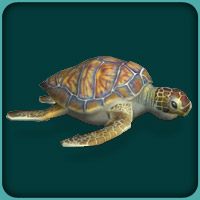
Expansion: Marine Mania
Fame: 1 star
Base Donation Amount: 60
Max Tour Value: 30
Adopt Rarity: 20
Prey Classification: Medium Prey (adult), Small Prey (young)
Zoopedia
Conservation Status: Endangered
Class: Reptiles (Reptilia)
Order: Testudines
Family: Cheloniidae
Genus: Chelonia
Species: mydas
Coastal
Global Warm Oceans


To unlock the green sea turtle in challenge or campaign games, you must earn a 1-star zoo fame rating for your zoo.
The green sea turtle is a large turtle named for the color of its fat, although the animal is brownish overall. It is the fastest swimming turtle, reaching speeds up to 32 km (20 mph). The green sea turtle is common in all warm seas and may sometimes be found, in summertime, along the North Atlantic coasts of the United States and Europe. Adults may reach a shell length of more than 1 m (3 ft) and a body weight of more than 180 kg (400 lb). It can be distinguished from other sea turtles in that it has a single pair of large plates on top of the head between the eyes, a relatively smooth shell lacking any ridges, and only four large, nonoverlapping plates on each side of the shell. The male never leaves the sea; the female leaves it only to lay her eggs. As many as 200 eggs are laid at night in sand above the reach of the sea. The young are hatched by the sun's heat and soon crawl into the sea. Green sea turtles are omnivorous but eat chiefly marine vegetation. They are prized by turtle hunters because their veallike meat is a table delicacy used in turtle soup and turtle steak; their eggs are also valued as food. Due to overhunting, the number of green sea turtles is rapidly decreasing.
Fun Green Sea Turtle Facts
- The green sea turtle is the largest hard-shelled marine turtle in the world. The Leatherback turtle is larger, but it is not hard-shelled.
- Baby green sea turtles use an "egg tooth" to break out of their shells when they hatch.
- As soon as baby sea turtles hatch they start moving their flippers. This causes the babies to rise out of the sand in which their eggs were buried, after which the infant turtles crawl to the water and swim away.
Content adapted from Microsoft® Encarta® Reference Library 2006. © 1993–2005 Microsoft Corporation. All rights reserved.
Errors and Trivia
Green sea turtles will, if any land or the desert island exists in the exhibit, occasionally wander onto it. In real life green sea turtles never venture onto land except to lay eggs. There's not much reason to considering there's no food for them there and they can barely move on it.
The green sea turtle was downgraded from Endangered to Least Concern by the IUCN in 2025.
Green sea turtles will sometimes get stuck when trying to leave the desert island.
Green Sea Turtle Exhibit Guide
The green sea turtle has the smallest space requirements in the entire game, needing only 12.5 squares for one animal and 18.75 for two. However, while it is still cheap, it is not the cheapest animal in the game due to its 1-star adoption cost and its need for both a shelter and enrichment. In addition, using the minimum space requirements shown here is not recommended until you have unlocked the water filter, as otherwise the water will go dirty faster than a dedicated zookeeper can keep up. Note that if you want a mating pair of turtles, you must have a patch of land for the female to lay eggs on. The desert island does count, though the game will still give you a notification saying the turtle does not have land to lay eggs.
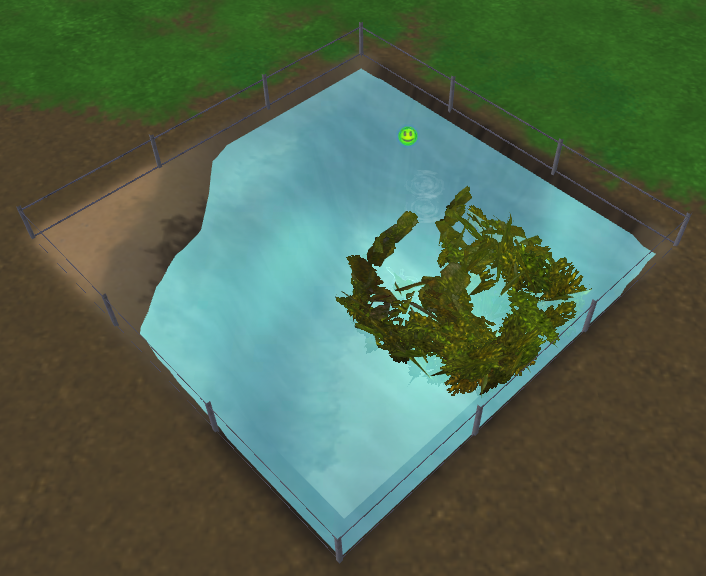
The cheapest exhibit plan I could find that takes up more than 12.5 squares is an oblique square costing $600. In the future I may do an article on how using diagonals affects Zoo Tycoon 2 fencing costs.
Adoption cost: $2,000
Space for first animal: 12.5 squares (50 triangles)
Space per additional animal: 6.25 squares (25 triangles)
Cheapest fence: Low chain link fence, low hedge fence, or post and rope fence, $50/square, $600 total for a 1-animal exhibit
Tank Depth: 3
Food: Seaweed, cheapest $100
Enrichment: Clam bubbler, $500
Shelter: Desert island or kelp bed, cheapest $400
Native Biome: Coastal (+10)
Other Compatible Biomes: Pelagic (+5), Reef (+5)
Total Cost: $3,600 for a 1-animal exhibit, excluding foliage or rocks
Compatible Animals (Coastal):
- aardvark
- addax
- Barbary ape
- Asiatic black bear—not compatible with community fixes installed
- beluga
- secretarybird*
- bongo
- African buffalo
- caracal*
- Asian elephant
- gelada
- gerenuk
- Masai giraffe
- pygmy hippopotamus
- West Indian manatee
- mandrill*
- meerkat*
- Nile monitor*
- musk ox
- narwhal
- sea otter*
- emperor penguin
- rockhopper penguin
- manta ray
- white rhinoceros
- Sivatherium
- Styracosaurus
- African spurred tortoise
- Galápagos giant tortoise
- Triceratops
- leatherback sea turtle
- giant warthog
- warthog
- wildebest
Compatible Animals (Other Biomes):
- whale shark (pelagic and reef biomes only)
*Will eat baby green sea turtles.