American Bison
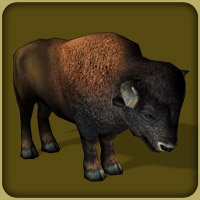
Expansion: Endangered Animals
Fame: 0.5 stars
Base Donation Amount: 60
Max Tour Value: 20
Adopt Rarity: 1
Prey Classification: Large Prey (adult), Medium Prey (young)
Zoopedia
Conservation Status: Lower Risk
Class: Mammals (Mammalia)
Order: Even-Toed Ungulates (Artiodactyla)
Family: Bovids (Bovidae)
Genus: Bison
Species: bison
Grassland
North America


To unlock the American bison in challenge or campaign games, you must earn a 1/2-star zoo fame rating for your zoo.
The bison is the largest terrestrial animal in North America, where it is commonly called buffalo. Biologists prefer the term bison, which is based on the animal's Latin name, as it distinguishes it from the cape buffalo of Africa and the water buffalo of Asia.
The bison is characterized by a hump over the front shoulders; short, sharply pointed horns (in both sexes) curving outward and up from the sides of the massive head; and slimmer hindquarters. A mature bull of the North American bison is about 2 m (about 6.5 ft) high at the hump and 2.7 to 3.7 m (9 to 12 ft) long and weighs 850 to 1100 kg (1800 to 2400 lb); the female is smaller. The head, neck, forelegs, and front parts of the body have a thick coat of long, dark hair. The rear part of the body is covered with much shorter hair. The adult bull usually has a black beard about 30 cm (about 12 in) long.
Bison are usually found in groups, except for old, solitary bulls. Most of the year females with young form small bands, and immature bulls may stay with them. Mature males have their own groups. The bands may congregate in large herds in the spring or fall to search for food or water. Bison grunts and snorts are audible at short distances. The roar of rutting bulls, audible at nearly 5 km (nearly 3 mi), is heard most often in mating season, mainly July to September, when bulls go looking for cows and try to ward off rivals. Breeding bulls have little time to eat and lose more than 90 kg (about 200 lb) during mating season. Gestation is eight to nine months, and a single yellow-red calf is born. After a few days the calf can keep up with the herd and follows its mother until the following spring.
The bison originated in Eurasia and is one of the few members of its family to have crossed the Bering Strait land bridge in prehistoric times to North America, where two subspecies, the plains bison and the wood bison, survive. The European bison, or wisent, taller but lighter than the American bison, is almost extinct; a few exist in parks and zoos.
Until the 19th century, as many as 60 million bison lived on the Great Plains from Mexico into Canada, and some were found east of the Mississippi River. They were central to the existence of the Plains peoples, who used them for food, hides, and bone implements; even the dried dung, called buffalo chips, was used as fuel. From 1830 to 1889, methodical destruction by encroaching white settlers, for sport and for hides, reduced this number to less than 1000. Today well over 200,000 bison live in protected areas and on private ranches.
Fun American Bison Facts
- The American bison's diet is made up mostly of grasses and sedges, along with the occasional berry or lichen.
- In the winter, the American bison uses its head and hooves to brush snow from vegetation.
- >American bison are most active in the early morning, late afternoon, and on moonlit nights.
- The American bison is so buoyant that its head, hump, and tail stay above water when it swims.
- American bison will stampede if frightened, reaching speeds of up to 32 MPH (50km/h).
- Most American bison living today are descendents[sic] of a small herd that was placed under government protection in Yellowstone Park in the early 1900s.
Content provided courtesy of Microsoft® Encarta® Reference Library 2005. © 1993–2004 Microsoft Corporation. All rights reserved.
Errors and Trivia
Recent genetic studies place bisons within the genus Bos, containing cattle. Others argue that incomplete lineage separation, morphology, or the fossil record justify keeping Bison a separate genus. Watch this space.
American Bison Exhibit Guide
Needs 2+ animals.
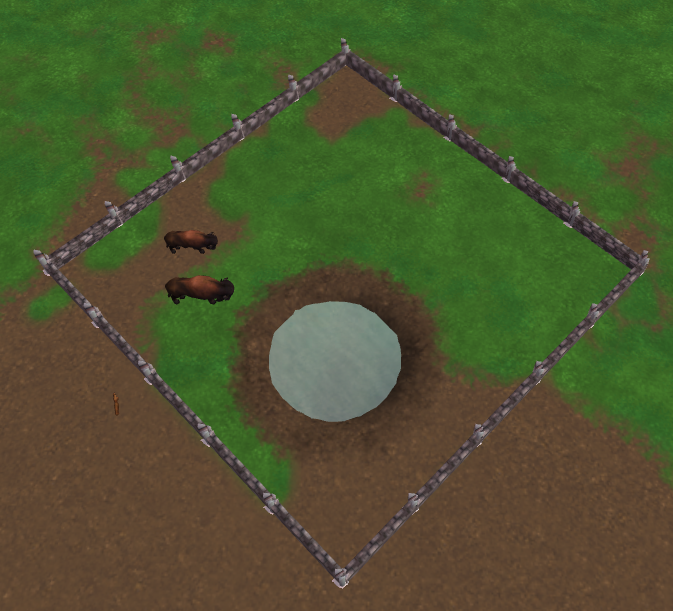
The cheapest exhibit plan I could find that takes up more than 43.75 squares is an oblique rectangle costing $1,500. In the future I may do an article on how using diagonals affects Zoo Tycoon 2 fencing costs.
Adoption cost: $1,250
Space for first animal: 37.5 squares (150 triangles)
Space per additional animal: 6.25 squares (25 triangles)
Cheapest Fence: Low tundra fence, $75/square, $1,500 total for a 2-animal exhibit
Food: None required (grazes and browses), eats grass, hay, and berries
Enrichment: None required, uses carrot and salt lick
Shelter: None required, uses shade structure, small wooden shelter, and stables
Native Biome: Grassland (+10)
Other Compatible Biomes: Boreal Forest (+2), Temperate Forest (0)
Swims?: Yes
Total Cost: $4,000 for a 2-animal exhibit, excluding foliage or rocks
Compatible Animals (Grassland):
- aardvark
- addax
- Barbary ape
- Asiatic black bear—not compatible with community fixes installed
- spectacled bear
- American beaver
- secretarybird
- bluebuck
- African buffalo
- dromedary camel
- giant camel
- caracal
- caribou
- cheetah*
- Doedicurus
- Asian elephant
- dwarf Sicilian elephant
- greater flamingo
- Thomson's gazelle
- gelada
- gemsbok
- gerenuk
- Masai giraffe
- reticulated giraffe
- hippopotamus
- Przewalski's wild horse
- striped hyena*
- ibex
- jaguar*
- koala
- Komodo dragon*
- ring tailed lemur
- meerkat
- Nile monitor
- moose
- okapi
- ostrich
- common peafowl
- rockhopper penguin
- quagga
- ratel*
- African spurred tortoise
- Triceratops
- warrah
- gray wolf*
- wolverine*
- common zebra
Compatible Animals (Other Biomes):
- aurochs (temperate forest biome only)
- bush-antlered deer (temperate forest biome only)
- Spanish lynx (temperate forest biome only)
- markhor (boreal forest biome only)
- American mastodon (boreal forest biome only)
- musk ox (boreal forest biome only)
- giant panda (temperate forest biome only)
- red panda (temperate forest biome only)
- emperor penguin (boreal forest biome only)
- Stegosaurus (boreal forest biome only)
- leatherback sea turtle (boreal forest biome only)
- Ethiopian wolf* (boreal forest biome only)
*Will eat baby bison.