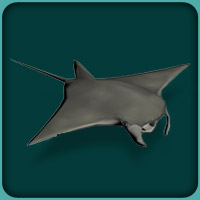
Manta Ray
Expansion: Marine Mania
Fame: 0.5 stars
Base Donation Amount: 60
Max Tour Value: 20
Adopt Rarity: 1
Prey Classification: Large Prey (adult), Medium Prey (young)
Zoopedia
Conservation Status: Low Risk
Class: Cartilaginous Fishes (Chondrichthyes)
Order: Myliobatiformes
Family: Mobulidae
Genus: Manta
Species: birostris
Reef
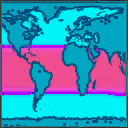
Global Warm Oceans

To unlock the manta ray in challenge or campaign games, you must earn a 1/2-star zoo fame rating for your zoo.
Manta rays are found in temperate and tropical waters near continents and island groups of all oceans. These cartilaginous fishes, also called devil rays and sea bats, have greatly extended, winglike pectoral fins. The largest, the Atlantic manta, can measure 7 m (23 ft) from tip to tip of these fins. The pair of forward-pointing lobes on each side of the head, with a presumed resemblance to a devil's horns, are used to guide plankton and small crustaceans into the fish's mouth as it cruises near the surface; dense gill rakers extract the plankton. The fish is harmless to humans, but its thrashing when caught can be dangerous.
Fun Manta Ray Facts
- Manta rays, like some whales, are filter feeders, collecting tiny organisms and small fish as they swim.
- Because manta rays are so large, their only real predators are large sharks.
- The manta ray is the largest species of ray in the world.
Content adapted from Microsoft® Encarta® Reference Library 2006. © 1993–2005 Microsoft Corporation. All rights reserved.
Errors and Trivia
When Zoo Tycoon 2: Marine Mania came out, manta rays were considered one species. Today, they are considered to be two or three by most researchers.
Genetic studies have also revealed that manta rays are descended from the living genus Mobula, which they have been reassigned to.
Manta Ray Exhibit Guide
.
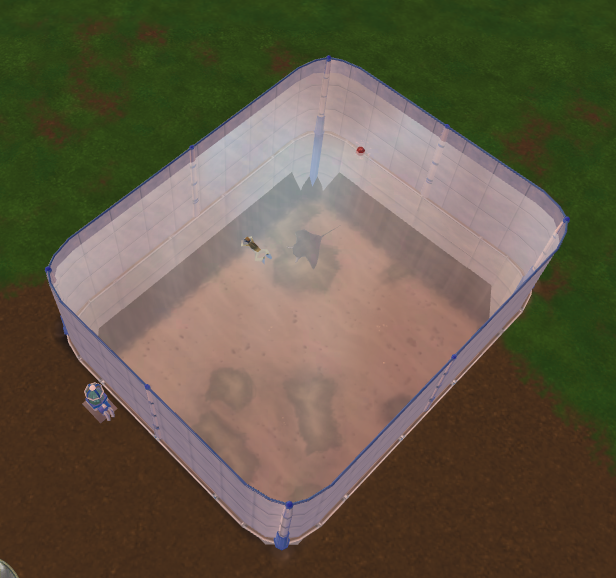
The cheapest exhibit plan I could find that takes up more than 35 squares is an oblique rectangle costing $1,350. In the future I may do an article on how using diagonals affects Zoo Tycoon 2 fencing costs.
Adoption cost: $1,250
Space for first animal: 35 squares (140 triangles)
Space per additional animal: 7.5 squares (30 triangles)
Cheapest Tank: Opaque tank wall, $75/square, $1,350 total for a 1-animal exhibit
Tank Depth: 4
Food: Zooplankton, cheapest $150
Enrichment: None required, uses clam bubbler
Shelter: None
Native Biome: Reef (+10)
Other Compatible Biomes: Coastal (+5), Pelagic (+5)
Total Cost: $2,750 for a 1-animal exhibit, excluding foliage or rocks
Compatible Animals (Reef):
- aardvark
- addax
- Barbary ape
- Asiatic black bear—not compatible with community fixes installed
- secretarybird
- bongo
- African buffalo
- caracal
- bottlenosed dolphin*
- Asian elephant
- gelada
- gerenuk
- Masai giraffe
- pygmy hippopotamus
- striped hyena*
- West Indian manatee
- mandrill
- meerkat
- Nile monitor
- musk ox
- emperor penguin
- ratel*
- white rhinoceros
- scalloped hammerhead shark*
- blacktip reef shark*
- whale shark
- Sivatherium
- Styracosaurus
- African spurred tortoise
- Triceratops
- leatherback sea turtle
- green sea turtle
- giant warthog
- warthog
- false killer whale*
- short finned pilot whale*
- wildebest
- Ethiopian wolf*
Compatible Animals (Other Biomes):
- beluga (only in coastal or pelagic biomes)
- Komodo dragon* (only in coastal biome)
- blue marlin* (only in pelagic biome)
- narwhal (only in coastal or pelagic biomes)
- sea otter (only in coastal biome)
- rockhopper penguin (only in coastal biome)
- California sea lion (only in coastal biome)
- Galápagos giant tortoise (only in coastal biome)
- Pacific walrus (only in coastal biome)
*Will eat baby mantas.